An engagement stone has to do more than look impressive beneath showroom lighting. It needs to retain its character through ordinary days, suit the wearer's personal style and work within a setting designed for regular use. Moissanite is particularly interesting in this respect because its appeal combines distinctive light performance with impressive hardness and considerable design flexibility.
For couples exploring beautiful moissanite engagement rings, understanding those characteristics makes it easier to choose for the right reasons. Moissanite is a gemstone in its own right rather than a type of diamond, and its optical properties give it a recognisable appearance. Shape, stone size, setting and precious metal can then be used to create anything from a restrained solitaire to a far more detailed engagement ring.
Understanding Moissanite's Distinctive Brilliance
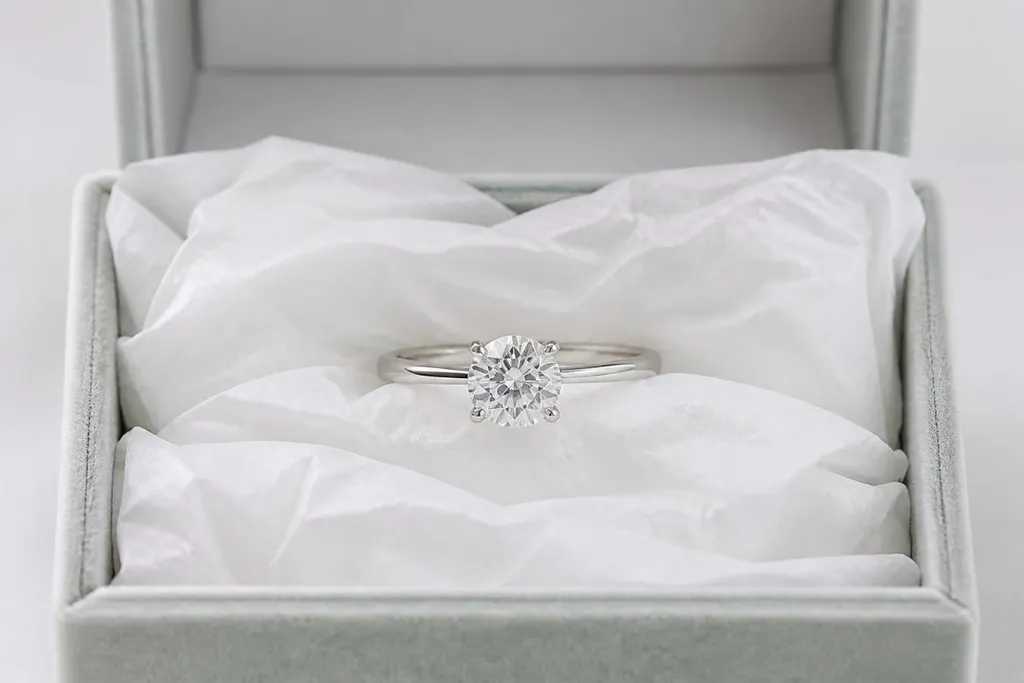
Moissanite is known for strong brilliance and particularly noticeable fire—the coloured flashes produced as white light is dispersed into spectral colours.
This can give the stone a lively appearance, especially in direct or bright lighting. Someone who enjoys an engagement ring with obvious sparkle may find this characteristic particularly appealing. Buyers looking for the exact visual behaviour of a diamond, however, should understand that moissanite handles light differently.
Its optical character can also become more apparent as stone size increases. A larger centre stone provides more visible surface area across which those reflections and coloured flashes can be seen.
This is why choosing between, for example, a 1-carat-equivalent and 2-carat-equivalent appearance is not simply a matter of wanting a larger ring. A wearer might prefer the larger option because they genuinely enjoy stronger visual presence and lively light performance. Someone with more understated taste may find a smaller stone better balanced with their everyday jewellery.
Durability Makes Moissanite Practical for Daily Wear
Engagement rings encounter far more contact than jewellery reserved for special occasions. Hardness therefore matters, particularly for the centre stone.
Moissanite measures approximately 9.25 on the Mohs scale, making it highly resistant to scratching and one of the harder gemstones used in fine jewellery. That quality makes it well suited to a ring intended for frequent wear.
Hardness does not make any gemstone indestructible. A sufficiently severe impact can still damage a stone or, more commonly, affect the surrounding setting. Claws can wear, bands can collect scratches and small accent stones may require occasional inspection.
Sensible care remains worthwhile. Removing an engagement ring for heavy manual tasks reduces unnecessary knocks, while gentle cleaning prevents creams, soaps and oils from building up on the stone and reducing its apparent brilliance.
Periodic professional checks can also confirm that the setting remains secure.
Shape Changes More Than the Outline
Moissanite is available in numerous cuts, allowing its appearance to be tailored considerably.
Round cuts emphasise symmetry and strong sparkle, making them an obvious choice for classic engagement designs. Oval stones provide an elongated silhouette and can create generous finger coverage without the width of a similarly prominent round stone.
Cushion cuts combine soft corners with substantial presence, while pear shapes introduce asymmetry and a graceful teardrop profile. Emerald-style cuts move in a different direction, using longer facets and stronger geometry for someone who prefers a calmer, more structured appearance.
Proportion matters alongside shape. An elongated stone can look substantial because of its length, while a well-balanced smaller stone may feel more appropriate with a fine band.
The best choice is the one that works visually with the wearer's hand rather than simply appearing largest on a specification sheet.
Use the Setting and Metal to Define the Style
A solitaire places moissanite's light performance at the centre of the design. It also keeps the ring versatile, allowing the stone's shape to establish most of its personality.
Diamond- or gemstone-set shoulders create additional brightness across the band, while halo designs increase the ring's overall visual footprint. Trilogy settings offer greater width and symbolism through three principal stones.
Metal changes the mood further. Platinum and white gold create a cool, crisp appearance, while yellow gold provides warmer contrast. Rose gold can soften the composition and works particularly well with curved shapes.
Practical details deserve attention too. Setting height affects everyday comfort, while gallery design determines whether a future wedding band can sit closely alongside the engagement ring.
Final Thought
Moissanite engagement rings combine distinctive brilliance with the durability required for jewellery worn regularly. Their appeal is strongest when moissanite is appreciated for its own optical character rather than treated simply as a substitute for another gemstone.
By considering size, cut, setting and metal together, it is possible to create a ring that feels deliberately chosen from every angle. Whether the preference is for a clean solitaire or a more elaborate design, moissanite offers enough versatility to make that decision genuinely personal.